Minecraft map Minecraft · All · Java + Bedrock

Slime Chunk Finder

Every slime-spawning chunk in your seed, mapped as a grid. Plan your slime farm location in minutes.

Slime chunks are specific 16×16 chunks in every Minecraft world where slimes spawn naturally — in Swamp biomes above Y=50 and in ALL biomes below Y=40. Slimes drop slimeballs (used in pistons, magma cream, leads, and slime blocks). Slime chunks are permanent per seed and can be built into slime farms.

Where
Y 0 to 39 (no biome restriction)
Biome
Any — chunk-based, not biome-based
Loot
Slimeballs (for sticky pistons, leads)
Danger
None
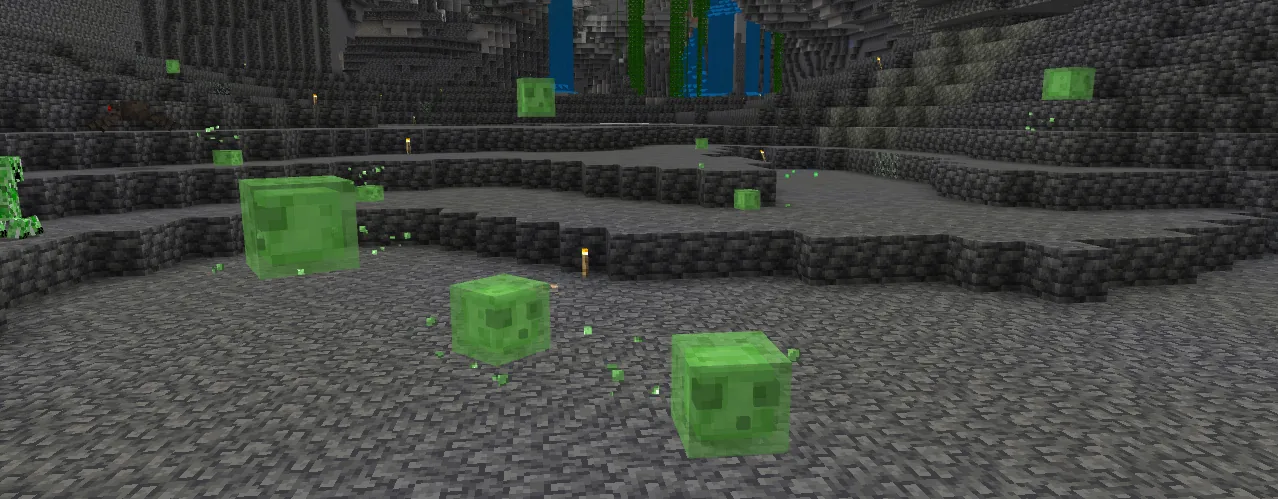
A Minecraft slime jumping in a dark underground cave — slime chunks let them spawn anywhere below Y 39
Jump to:
🏠
Village
🏛️
Stronghold
🏗️
Monument
⛩️
Temple
🏚️
Mansion
X: 0   Z: 0   |   -   |   Seed: -
Overworld — Java 1.21.4

Slime Chunks Found

Sorted by distance from 0,0

Enter a seed to find structures

Save Your World Map

Create a free account to save custom markers, track explored structures, and share your world.

Slime chunks are special 16×16 block areas where slimes spawn below Y level 40 regardless of light level. The SeedLander Minecraft Slime Chunk finder maps every Slime Chunk across a wide radius in your world, which is essential for building efficient slime farms that produce slimeballs and slime blocks.

Approximately 1 in 10 chunks are Slime Chunks. On Java Edition the selection depends on your world seed, so every seed has a different set; on Bedrock Edition the slime chunks are the same coordinates in every world, independent of seed. Either way, without a finder tool identifying them requires tedious underground trial and error — digging out rooms at the right depth and waiting to see if slimes appear. SeedLander shows you exactly which chunks qualify on both editions.

Slime blocks and slimeballs are essential crafting ingredients for redstone contraptions, sticky pistons, leads, and magma cream. Technical Minecraft players need large quantities of slime for flying machines, item sorters, and automated farms. A dedicated slime farm in the right chunk provides a renewable supply of these materials without any ongoing effort.

The Minecraft Slime Chunk finder displays results as a grid overlay on the interactive map, with Slime Chunks highlighted so you can easily spot clusters. Adjacent Slime Chunks are particularly valuable because they can be combined for larger spawning platforms with higher output. The finder helps you evaluate multiple potential farm locations before committing to the significant excavation required.

Minecraft Slime Chunk finder displaying slime spawning chunk grid overlay on the SeedLander seed map

Frequently Asked Questions

How Slime Chunks Work in Minecraft

Slimes are lovely, bouncy, frustrating to farm — and almost impossible to find efficiently without a tool. That's because regular slimes only spawn in about one in every ten chunks below Y 40, and those "Slime Chunks" are determined by your world seed. They don't look any different on the surface. Unless you know where they are, you're either swamp-hopping on full moons or cave-mining blind and hoping.

The finder above does the work for you. Pop your seed in, pick your edition, and every Slime Chunk in a wide radius is plotted out on the map. You can AFK-mine one out and call it a farm, or — for the real slimeball economy — build a proper automated farm on a confirmed Slime Chunk. The full Seed Map shows Slime Chunks overlaid on biomes, which makes picking a chunk close to your base much easier.

Multiple Minecraft slimes jumping in a dark cave — the active spawn pattern of a slime chunk
A slime chunk in action — once you're standing in one below Y 40, slimes spawn freely as long as the area's dark.

The Rules Behind Slime Chunks

A few quick facts that make the difference between "a farm that works" and "a farm that's somehow empty".

  • Which chunksRoughly 10% of chunks in every seed are Slime Chunks. They're set when the world is created, and the finder shows you exactly which ones in your seed so you can pick the best spot.
  • Spawn depthSlimes only spawn below Y 40 in Slime Chunks. They ignore light level (unlike most hostile mobs), so your farm doesn't need to stay dark.
  • SwampsOutside Slime Chunks, slimes also spawn in swamp biomes between roughly Y 50 and Y 70 at low light. Spawn rates are tied to the moon phase — full moon gives the highest chance, new moon blocks them entirely. It's slower than a chunk farm but works if you can't travel to a confirmed chunk.
  • Mangrove swampsMangrove swamps spawn slimes the same way as regular swamps, with the same moon-phase modifiers. That's handy if one happens to sit near your base — you can build a small surface farm without needing to travel to a Slime Chunk.
  • Despawn ruleSlimes will despawn if you're more than around 128 blocks away from them, so where you AFK in your farm matters. Too close and they don't get a chance to spawn around the chunk; too far and they vanish before reaching the kill point.

Building a Simple Slime Farm

If you've found a nearby Slime Chunk, you're about twenty minutes away from never crafting slimeballs again. A basic farm is just an open room at the right Y level in the right chunk — no redstone tricks needed for a starter version.

  1. Get to Y 30 inside the Slime Chunk. A chunk is a 16×16 column of the world running from bedrock to the build limit, and the finder pin marks the corner of the slime-spawning chunk. In Java Edition you can press F3 to bring up the debug screen and F3+G to overlay chunk borders so you can see the boundaries clearly. Mine down to roughly Y 30 — slimes spawn anywhere below Y 40 but Y 30 gives you a comfortable ceiling for the farm.
  2. Hollow out a 16×16×4 room aligned to the chunk borders. Slimes can spawn in any air block within the Slime Chunk that's below Y 40, so the bigger the cleared volume the higher the spawn rate. A single 16×16×4 floor is the minimum useful size; a multi-floor stack of those rooms (each 4 blocks tall, separated by a 2-block ceiling) is the standard high-rate design once you scale up.
  3. Light up every dark cave within 128 blocks of the farm. The game limits how many hostile mobs can exist around a player at once (the "mob cap") — and that cap is shared across every dark spawnable space inside your simulation radius. A single unlit cavern can fill up with regular zombies and skeletons that count against the cap, leaving no "room" for slimes to spawn in your farm. Torch every nearby cave aggressively before testing the rates.
  4. Build a kill mechanism that handles all three slime sizes. Slimes spawn in three sizes — big (4 blocks wide), medium (2 blocks wide) and small (1 block wide). Big and medium slimes split into smaller versions when killed rather than dying outright, so a flush mechanism (water streams pushing them into a hole) plus damage at the bottom (Magma Blocks, a fall, or a fire trap) is the standard setup. Place the killing block where only the small slimes can reach it so the splits funnel down naturally.
  5. Find the right AFK spot — usually 23 to 24 blocks above the farm. Hostile mobs only spawn 24 to 128 blocks from the player, and despawn when you're more than 128 blocks away. Stand too close and slimes won't spawn at all; stand too far and they despawn before reaching the killing chamber. An AFK platform 23 blocks above your room — far enough that the room is in the spawn zone but you're still close enough to keep slimes loaded — gives the most consistent rates.

What You Actually Use Slimeballs For

It's easy to underestimate how much late-game stuff needs slimeballs. Sticky pistons for farms and base mechanisms, magma cream for potions of fire resistance, leads for pets and animals on walks, slime blocks for bouncy builds and piston-powered machinery. If you've been playing on a world for more than a few months and never built a farm, there's a good chance you've got something stuck in your to-do list because "I need more slimeballs first". A confirmed Slime Chunk fixes that for good.

Pin your slime chunk

Creating a Free World on SeedLander shows every Slime Chunk across a wide radius in your seed. You can also add custom markers and portals for the spots that matter to you.

Premium World (£1.99/mo per world, first 14 days free) lets you mark your active slime farm and note your AFK coordinates, add unlimited custom map markers and portals, and share routes with your team mates (with our team addon).