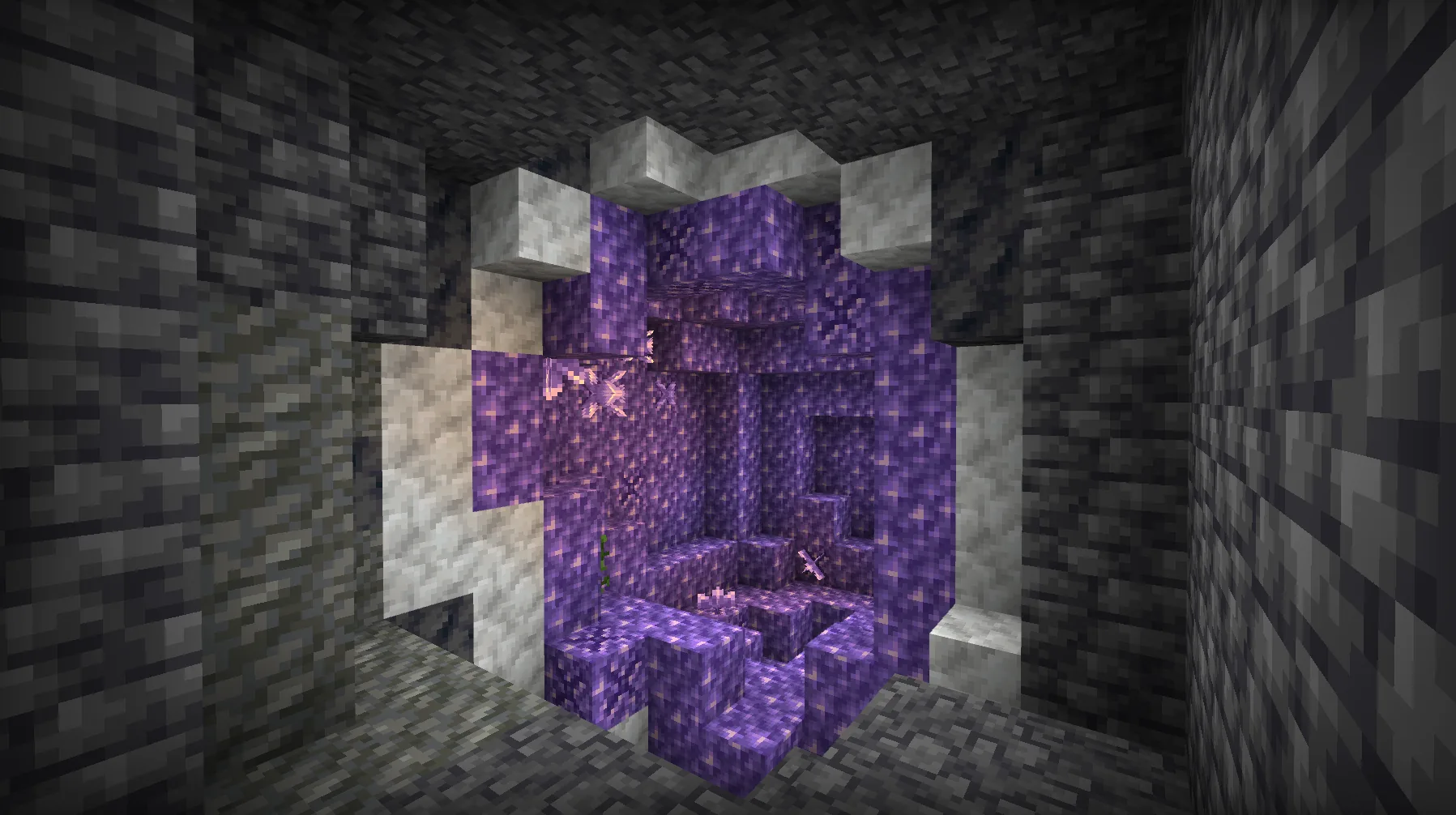
Amethyst geodes are pocket-sized treasure caves. Crack one open and you find purple crystal clusters, smooth basalt walls, and the only natural source of budding amethyst — a renewable block that grows new amethyst clusters over time. They are the source of every spyglass, tinted glass block, and amethyst shard in the game.
Here is how to find one and how to set up a renewable amethyst farm.
What Is an Amethyst Geode?
A geode is a small spherical cave structure made up of three layers:
- Outer shell — smooth basalt
- Middle layer — calcite (the white speckled stone)
- Inner shell — amethyst blocks and budding amethyst, with growing crystal clusters inside
The inside of a geode glows softly purple from the amethyst clusters. Cracking through the basalt and calcite to reach it is the typical “wow” moment of discovering one.
Where Geodes Generate
Geodes generate in any Overworld biome, anywhere from Y=-58 up to about Y=30. They are most common in the lower half of the cave system. Most geodes are entirely sealed inside stone, but a few partially break the surface or open into existing caves.
You will sometimes see smooth basalt or calcite in a cave wall — that is a geode boundary. Mine into it.
How to Find a Geode
Method 1: Use a Seed Map
The fastest method by miles. Drop your world seed into the SeedLander seed map and switch on the geode overlay. Geode positions show as small dots on the map, with coordinates. Mine straight down to one and break through.
Geode generation differs between Java and Bedrock for the same seed — pick the right edition.
Method 2: Watch for Calcite or Smooth Basalt in Caves
If you spot calcite (white speckled stone) or smooth basalt (dark, smooth, almost-marble-like) in a cave, you are looking at the outer layer of a geode. Mine through it carefully — you do not want to fall straight through into a deeper cave.
Method 3: Listen for Amethyst Chimes
Amethyst clusters emit a soft musical chime when walked past or stepped on. If you hear xylophone-like notes while exploring caves, follow the sound. You are very close to a geode.
What to Collect
Once inside a geode, here is what to mine:
- Amethyst shards — drop from breaking fully-grown amethyst clusters with any pickaxe. Used for spyglasses (1 shard + 2 copper ingots) and tinted glass (4 shards + 1 glass).
- Amethyst blocks — break the inner shell. They emit a chime when walked on, useful for redstone-free notification systems.
- Calcite — the white middle layer. Decorative building block.
- Smooth basalt — the dark outer shell. Another nice building block.
Important: do not break budding amethyst. It looks darker and bumpier than the smooth amethyst block, and it grows new amethyst clusters over time. If you break it, even with Silk Touch, it disappears — budding amethyst cannot be mined and reused.
Building a Renewable Amethyst Farm
Budding amethyst grows new clusters on the four directly-adjacent sides over time. Each cluster goes through four growth stages: small bud, medium bud, large bud, fully-grown cluster. Only the fully-grown cluster drops 4 amethyst shards (with Fortune III, up to about 6).
To build a basic farm:
- Find a budding amethyst block in the geode.
- Mine the calcite around it but leave the budding amethyst in place.
- Place a sticky piston facing each side of the budding amethyst.
- Wire the pistons up to a redstone clock that fires every few minutes.
- Place hoppers and a chest below to catch the dropped shards.
Crystals grow in real time and the pistons knock fully-grown ones loose. The farm runs whenever the chunks are loaded.
Tips and Tricks
- Break clusters with hand or any pickaxe. Cluster blocks always drop shards regardless of tool. Pickaxe is faster.
- Use Fortune III on amethyst clusters. Significantly more shards per break.
- Tinted glass is the only redstone-blocking glass. Worth crafting some for builds.
- Calcite makes great paths. The white texture is easy to see at night and contrasts nicely with most biomes.
- Save budding amethyst. Even if you accidentally Silk Touch one, it still vanishes. Mark each block and never touch it.
Geodes are short, sweet, and rewarding. Drop your seed into the seed map, find the nearest one, and bring an iron pickaxe.
For the technical details on amethyst cluster growth and geode structure, see the Minecraft Wiki page.